- The yew is a tree with rough bark,
- hard and fast in the earth, supported by its roots,
- a guardian of flame and a joy upon an estate.So says the Anglo-Saxon Rune Poem.
- The yew has a healthy grip on life and, despite its longevity, is often associated with death.
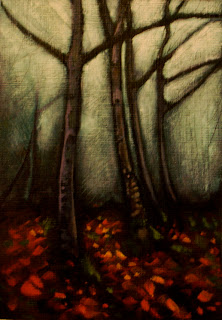
Commonly found in churchyards, yew may have been planted as a reminder of long life, or to discourage farmers from allowing livestock to wander onto church property, the poisonous foliage being a disincentive. Which brings us to the fact that almost every part of the yew is poisonous. This might account for its charm. The beautiful red berry-like arils are an exception. They taste quite nice. The seed inside is highly toxic, but obviously those can be avoided. Birds don't digest them, just pass them on through their droppings. Yew wood was commonly used in the production of longbows, but since much of yew is knotty and twisted, suitable yew staves were being imported to England as early as 1294, part of a trade that was to deplete the forests of southern Germany and Austria of mature yew trees by the 17th century. Happily, the rise of firearms relaxed the demand for the supply of yew wood. Imagine where we'd be without guns. Yew bark is extraordinary. The gnarled, twisted trunks create their own landscape to negotiate. Hence the study. As Wordsworth wrote of the dualistic nature of these splendid trees:
Knotty Yew! K Howell 2012 Pastel on Paper 9cm x 11cm - Of vast circumference and gloom profound This solitary Tree! -a living thing Produced too slowly ever to decay; Of form and aspect too magnificent To be destroyed.
- Do you have a favourite yew?
Monday, 9 January 2012
Dreaming of Yew


Monday, 2 January 2012
For the rain it raineth every day...
 |
| Wet Day K Howell 2011(barely) Pastel on Paper 28cm x 28cm |
But why this foolish attachment to atmospheric necessity?
1 The Smell: is indescribable, beyond anything and simply invigorating.
2 The Impact: it stings and weighs you down, but ultimately leaves you refreshed.
3 Reliability: It Will Rain, and the Rain Will Continue. Isn't that a soothing thought?
4 Aesthetics: Behold yonder branch from which a droplet hangs. This is pleasing.
5 It Will Rise Again!: Fallen droplets are assumed into the atmosphere, allowed to collect, and are respent upon the world. There might be something in this idea...
Yes, the rain makes us wet. Yes, it leaves puddles at the edge of the road, carefully situated near bus stops. But rain is Inevitable! Necessary! Embrace the Rain! After all, the dog shit on the pavements doesn't clean itself up...
Saturday, 24 December 2011
The Present
 |
| Last Year's Snow K Howell 2011 Acrylic on Paper 21cm x 14cm |
We've passed the year's midnight. A time to live in the present. Best wishes for a festive season, and a reminder of last year's snow! Who knows what will come?
Saturday, 17 December 2011
Dressed in Fog
 |
| Lost Leaves K Howell 2011 Acrylic on Paper 21cm x 30cm |
But where does sense get anyone?
In the book Don't Ask Me What I Mean (poets talking about the business of poetry), Ted Hughes describes his writing as a celebration of the solidity of his illusion of the world. And this I find heartening, so I pass it on. A wonderful description of the inside out nature of attempting to recreate an aspect of the world in order to understand it.
Thursday, 8 December 2011
Let it snow?
 |
| Window onto Winter IV K Howell 2011 Available at Water Street Gallery |
Interesting phenomenon, the creation of snow globes. Shavings of human bone used to provide the 'snow' in the nineteenth century, which was the only redeeming thing I could think of to say to my children whilst trapped there. I may have elaborated slightly, the bone used may not have been exclusively human. But I prefer to think so, so I'm refusing to look it up.
It's an overwhelming time of year. I need Snow, that's all.
Anyone have a skeleton in the closet?
For an intriguing take on the snow globe, see here.
Thursday, 1 December 2011
Shedding Leaves with Marcus Aurelius
 | |||||||||
| Excuse me, have you dropped something? |
Look beneath the surface: never let a thing's intrinsic quality or worth escape you.
I have a thing about Marcus Aurelius. I was introduced to his meditations when I was a charming adolescent at the rocky heights of wisdom and humility. Something of his voice must've penetrated my thick skull because I still have his book and he turns up now when I most require his Soundness. Men exist for each other, he says. Then either improve them or put up with them. These are fine thoughts to hold on to when things get irritating on public transport.
Marcus Aurelius understands the Immediate. He appreciates transformation and our tiny role in the greater cycle. Only a little while, he says, and Nature, the universal disposer, will change everything you see, and out of their substance will make fresh things, and yet again others from theirs, to the perpetual renewing of the world's youthfulness.
The ground beneath our feet is covered with a scattering of gold and copper. Autumn's alchemy. Swirled in the cold breath of approaching winter. Beautiful.
So it is to Marcus Aurelius that I turn when I see a man out with a turbocharged leaf-blower. What a piece of equipment. The noise! The futility! Why, Marcus? WHY??
Thursday, 24 November 2011
Clarity
 |
| Limber K Howell 2011 Pastel on Paper 14 cm x 21 cm |
Mornings have been foggy. Very atmospheric. Quite conducive to contemplating the yogic exercises of trees.
I love the rich reduction of autumn. A new clarity in the bare trees. Crisp line and hanging mist. The sharp smell and cold air preparing the way for winter.
Don Paterson, in his Book of Shadows, says:
The trees in winter, those exact diagrams of all our dead yearnings.
It's a terrible thing to be distracted from work by an aphorism.
Subscribe to:
Posts (Atom)